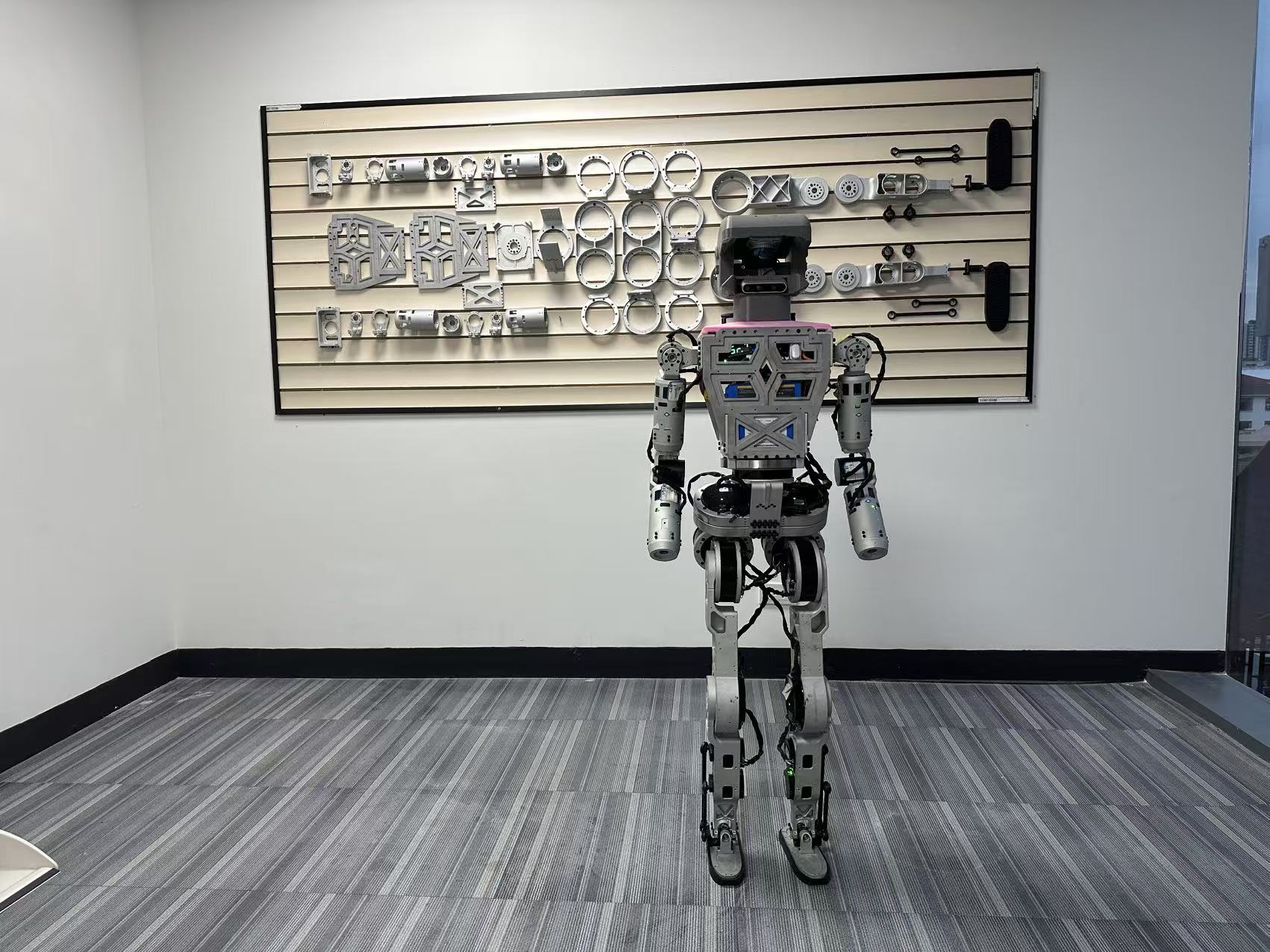
Hardware modules
Control, drive, sensing, structure, and power — standard interfaces, easy to reassemble, ready for secondary development.
Smart Haven
Thailand hardware R&D · Thailand algorithm R&D · Thailand market operations. Humanoid robots and education programs for schools, security, and custom scenarios.
Built in Thailand
Thailand-local hardware R&D + Thailand-local algorithm R&D + Thailand-local market operations — full-stack capability for education, security, and custom scenarios.
Local product definition, hardware design, and manufacturing
Local AI and motion-control algorithm development
Local channels, marketing, and customer service
Flagship
1.25 m · 34 kg · 23 DOF. From hardware assembly and reinforcement learning to real-robot deployment — Make → Train → Deploy.
Smart Education · Robot Customization · Empowering the Future
Universities
From components to full systems — Disassemble → Assemble → Debug → Apply. For robotics, mechatronics, intelligent manufacturing, AI, and automation programs.
Control, drive, sensing, structure, and power — standard interfaces, easy to reassemble, ready for secondary development.
Low-level drivers, PID and motion control, path planning; C/C++, Python, and ROS supported.
Hardware assembly → Algorithm training → Deployment. Each stage can be a course or a year-long project track.
Videos, lab manuals, lecture slides; customization, teacher training, warranty, and technical support.
Training series
Four stages — lamp, arm, wheel, then biped. Every robot is assembled by the student from parts. Hours below are for secondary students starting from zero: one 90-minute class a week. Primary groups need about one-third more time at each stage.
What you learn
Mechanical conversion, ESP32 programming, servo control, keyframe animation, sensors, and face following.
Milestone
Assemble a lamp that looks up, nods, and turns to follow a person.
What you learn
Build a 6-joint arm, bus servos, coordinates and introductory kinematics, teach-and-replay, leader–follower teleoperation, and vision grasping.
Milestone
The arm sees a colored block, picks it up, and places it on a marked spot.
What you learn
Differential chassis, encoded motors, PID speed control, line following and obstacle avoidance, phone remote control, and an introduction to LiDAR mapping.
Milestone
The car follows a line, avoids obstacles, and finishes a task course on its own.
What you learn
Assemble a desktop biped, set joint zeros, use an attitude sensor, balance and center of mass, design a gait, and try simulation plus introductory reinforcement learning.
Milestone
Standing steadily around month 8. Walking straight and turning around month 10.
Stage 4 uses a desktop biped about 30–40 cm tall, not a life-size humanoid. A full-size humanoid is a research project and an optional path after graduation. Each stage can be taken on its own. Students who already have a background may start at stage 2 or 3 after an assessment. The four stages are 80 lessons. Two classes a week compress the path to about five months.
Primary: grades 4–6 (about 9–12). Block-based programming instead of written code. Key parts are prepped in advance, and tools such as a hot-glue gun are not used. The teacher demonstrates each step. Each stage takes about one-third longer (the lamp stage is 16 lessons). The biped stage is recommended from age 12.
Secondary: middle and high school (about 12–17). Students write real code in Arduino and Python, on the lesson counts listed above.
Under 9 is not enrolled yet. Fine motor control and attention span are not enough to assemble independently. A block-building intro class is the better start.
Parents sign a filming consent before any recording. Videos are for that student’s portfolio and for checking the certificate. Using them in public promotion needs a separate consent.
After the four stages we select a team, train for about 3–6 months against that year’s calendar, and enter RoboCupJunior soccer — regional or national events first, then the international event.
For secondary students starting from zero, 8 lessons can cover the topics but rarely leave every student with a robot that runs reliably on its own, so we use 12. The extra 4 lessons add no new topics. They are for the steps that stall: assembly and wiring, joint calibration, vision tuning, and time to film and present. An 8-lesson plan fits students who already code, or a camp with about one assistant per four students and parts prepared in advance. Primary groups add 4 more lessons, 16 in total, and use block coding instead of written code.
Students only touch a 5 V supply. The lamp’s original mains wiring is removed by the teacher before class. Joint limits are enforced in software, and a teacher or assistant checks the wiring before every power-on. Primary groups do not use a hot-glue gun; the teacher prepares those parts.
Thailand focus
Thailand as the hub for public security, eldercare, education, and localized operations.
Live demos
Footage from our lab and assembly floor.
Partnership
Standard kits, custom packages, lab co-building, or faculty training — we welcome a deeper discussion and live demo.